As global populations age, organizations face increasing pressure to support an age-diverse workforce. This study investigates how employee perceptions of age-diversity practices influence company ratings and whether these effects diminish over time. Using a dual-method approach, researchers analyzed 1,245 employer reviews over 14 years and conducted a longitudinal experiment. Results indicate that while age-diversity practices initially enhance company ratings and perceived organizational support (POS), these effects “fade” as employees adapt to the initiatives as a “new normal.” The findings highlight the time-sensitive nature of employee reciprocity and underscore the need for organizations to continuously monitor and renew their diversity efforts to sustain long-term positive evaluations.
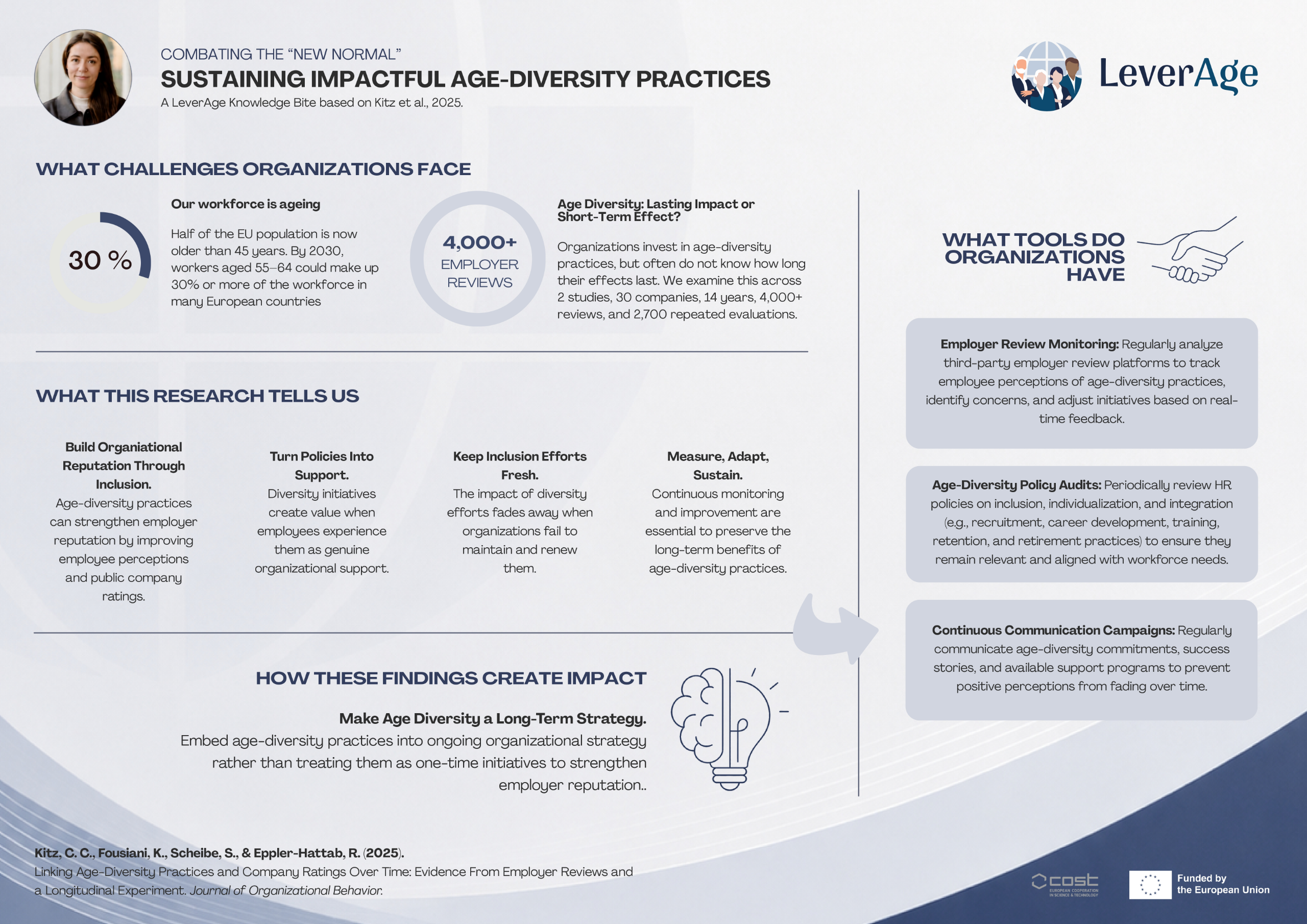
Key Findings
- Positive perceptions of age-diversity practices are significantly associated with higher overall company ratings on public employer review platforms.
- Perceived organizational support (POS) mediates the relationship between age-diversity initiatives and the positive evaluations provided by employees.
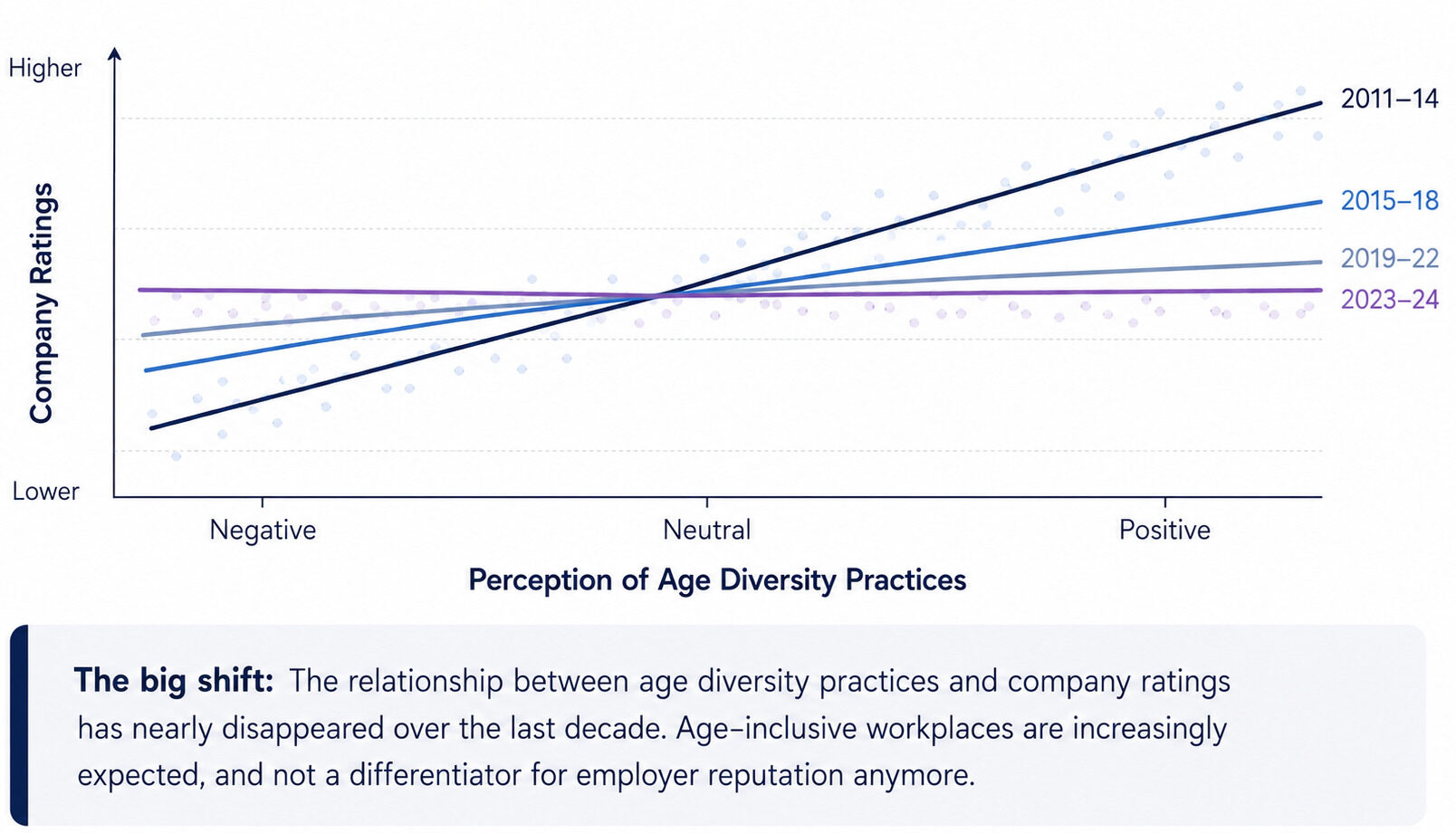
- The positive impact of age-diversity practices on company ratings fades over time as employees perceptually adapt to them.
- Organizations must continuously monitor and renew diversity efforts to sustain their effectiveness and maintain favorable employee evaluations.
Challenge
Organizations must implement age-responsive practices to sustain competitive advantage and employee well-being in an aging workforce. However, many organizations fail to account for the temporal dynamics of these initiatives. Without understanding how employee perceptions evolve, companies risk overestimating the long-term benefits of diversity efforts. The challenge lies in sustaining the positive impact of these practices as employees adapt and begin to view them as a routine baseline rather than a discretionary benefit.
Research
The authors conducted a large-scale field analysis using sentiment analysis on 1,245 public employer reviews from 30 companies over 14 years. They complemented this with a longitudinal experiment involving 300 participants over nine time points, manipulating age-diversity meta-strategies—Inclusion, Individualization, and Integration—through simulated HR newsletters. This approach combined real-world discourse with controlled experimental manipulation to examine how perceptions of age-diversity practices influence company ratings through perceived organizational support.
Findings
Study 1 revealed that positive mentions of age-diversity practices in employer reviews correlate with higher numerical company ratings, but this relationship weakens over years. Study 2 confirmed that age-diversity initiatives boost company ratings by increasing perceived organizational support (POS). However, consistent with adaptation-level theory, repeated exposure to these practices led to a “fading effect,” where their influence on POS and subsequent ratings diminished over time. Notably, this fading effect occurred regardless of employee age. While age-diversity practices are crucial for shaping early positive views, they eventually become part of the “new normal,” reducing the sense of reciprocal obligation from employees.
Impact
This research offers strategic guidance for organizations to manage an aging workforce effectively. It proves that age-diversity practices are powerful signals that enhance company reputation and employee loyalty. To prevent the “fading effect,” managers should avoid “set-and-forget” policies and instead engage in continuous maintenance, evaluation, and refreshed communication of diversity initiatives. Using employer review platforms as a cost-effective monitoring tool can help organizations align practices with evolving employee expectations. Sustained commitment—rather than one-off implementations—is essential to foster long-term intergenerational collaboration, retain talent, and maintain a competitive edge in an aging global market.
Reference
Kitz, C. C., Fousiani, K., Scheibe, S., & Eppler-Hattab, R. (2025). Linking Age-Diversity Practices and Company Ratings Over Time: Evidence From Employer Reviews and a Longitudinal Experiment. Journal of Organizational Behavior.
Contact:
- Main author: Claudia C. Kitz
- Email: c.c.kitz@rug.nl
Links:
- Published paper: https://onlinelibrary.wiley.com/doi/10.1002/job.70015