People are living longer and we researched how easy it is for them to work longer, and how they make that decision. We asked executives in their mid- and late-stage careers about their career decisions. We found two interacting factors which could extend the sustainability of a mid- and late-stage career: first, personal motivation, when individuals re-engaged actively with their careers; and secondly, contextual opportunities, which enabled individuals or their organizations to reinvent their careers. We also found that in addition to the individuals themselves, different decision-makers contributed to each decision. We drew up a Career Sustainability Matrix, designed to enable mid- and late-stage workers to identify whether their career is sustainable, and how to extend their career sustainability.
Key Findings
- Traditional career scripts often run out before executives are ready to retire, due to increasing longevity and precarious work.
- To sustain their careers, individuals need both personal motivation and opportunities offered by their organisations.
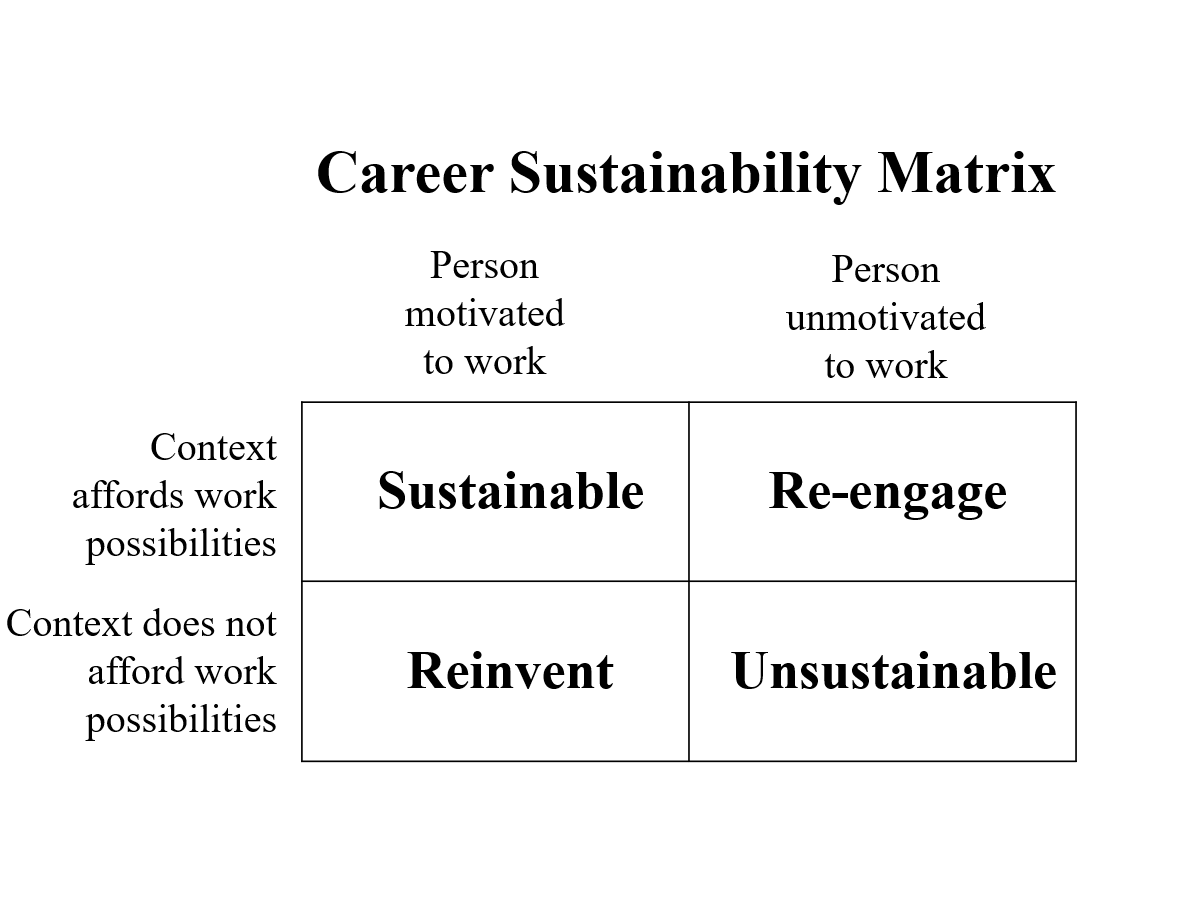
- Our new Career Sustainability Matrix identifies strategies to re-engage with or reinvent their mid- and late-stage careers instead of retiring.
Challenge
People are living longer lives and therefore need to work longer. However, neither organisational career development, nor the individual’s expectations, are designed to last until the State Pension Age and beyond. How do people make decisions to extend their mid- and late-stage careers, and how do we support their careers to make them more sustainable?
Research
| Design | Executives in their mid- and late-stage careers were interviewed about their career decision-making, including their motivations and opportunities and plans for their future. |
| Methods | We used semi-structured interviews and analysed them thematically using an abductive approach. |
| Sample | The sample consisted of 40 economically active executives aged from 38 to 73 years, 23 male and 17 female. |
| Timespan | The research was carried out over a few months in 2017. |
Findings
The same individual made their career decisions according to different criteria at different life and career stages. The decision-making process often incorporated friends, family and organisations, as a combination of interactive decision-makers in a Decision-Making Unit (DMU). Within organisations, decisions followed a script derived from current career opportunities and precedents. At a later career stage, retirement was an economic alternative to sustaining a career. Two major factors interacted to determine whether an individual’s mid- and late-stage career was sustainable or unsustainable: firstly, the motivation of the person to work, to leave work, or to retire; and secondly, the opportunities provided by the context.
Impact
To sustain their mid- and late-stage careers, individuals should re-engage with their career, using lifelong learning and job crafting, or reinvent their career, in a new employed or self-employed role. Organisations need to provide alternative career paths at different levels of intensity, to offer sustainable career development. They need to offer new opportunities in the same role, with reduced hours, or alternative roles, and to offer more innovative and meaningful mid- and late-stage career paths with flexible hours and pay. To assist with mid- and late-stage career decision-making and understanding, we created an original Career Sustainability Matrix, as shown below.
Reference: Hallpike, H., Van der Heijden, B. I. J. M., & Vallée-Tourangeau, G. (2025). What do you do when your career script runs out? How older workers decide whether and how to sustain their careers. Work, Aging and Retirement, 11(1), 97-118. https://doi.org/10.1093/workar/waad027
Contact
- Main author: Dr. Helen Hallpike
- Email: H.Hallpike@Kingston.ac.uk
Links
- Published paper: https://academic.oup.com/workar/article/11/1/97/7589727
- Additional links: https://www.linkedin.com/in/beatrice-van-der-heijden-884500/ , https://www.linkedin.com/in/profgaelle/