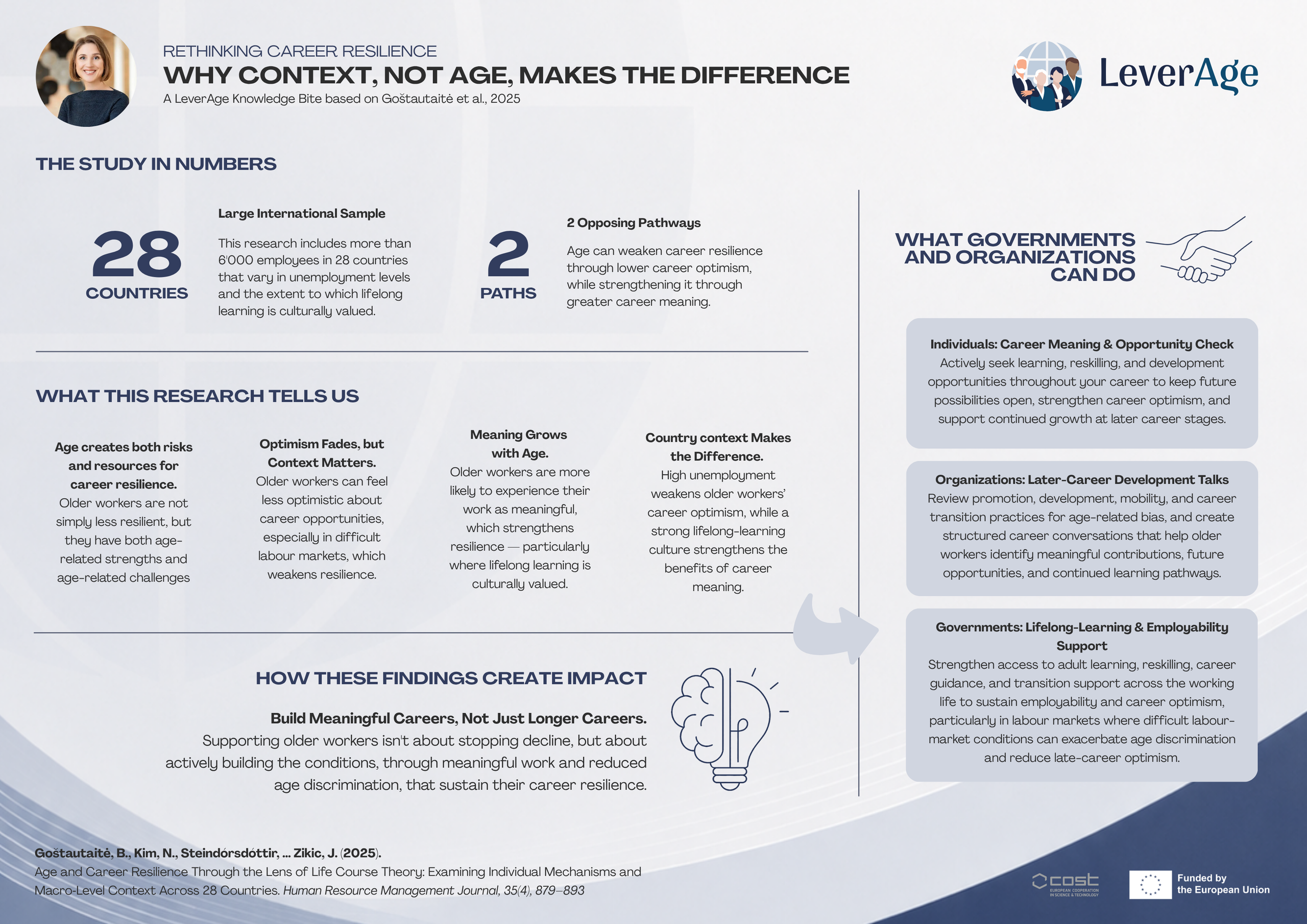
As populations age and people work longer than ever before, many employers and governments worry that older workers may naturally have reduced career resilience — the ability to adapt to changes, recover from setbacks, and stay engaged in one’s career. Our global study tells a very different story. Drawing on primary data from 6,772 professionals across 28 countries, we found that age shapes career resilience in two opposite ways. Older workers may feel less optimistic about future career opportunities, yet at the same time, they are more likely to see their work as meaningful. What is more, career resilience is shaped not only by these personal resources, but also by the country people live in.
Key Findings
- Older workers are not uniformly less resilient; they face both age-related risks and age-related strengths.
- Older workers may feel less optimistic about future career opportunities, especially in countries with higher unemployment, which reduces career resilience.
- Yet, older workers are more likely to experience work meaningfulness, which strengthens resilience—particularly in countries with a stronger culture of education and lifelong learning.
Challenge
Many organizations want people to work longer, but age stereotypes still get in the way, portraying older workers as less adaptable and less resilient. These biases can shape hiring, development, and retention decisions in harmful ways. At the same time, research has offered mixed and sometimes contradictory evidence on whether age helps or harms career resilience. Our study set out to clarify what really happens and to identify the conditions that help older workers remain resilient in changing labor markets.
Research
To answer this puzzle, we surveyed 6,772 managers and professionals across 28 countries. We examined whether the relationship between age and career resilience can be explained by two mechanisms: career optimism and career meaning. We also combined this primary dataset with archival country-level data from sources including the World Bank, the OECD, and the World Values Survey. This allowed us to test whether these relationships depend on national context, particularly unemployment rates and the culture of education.
Findings
The study showed that age affects career resilience through two opposing pathways. First, older age was linked to lower career optimism, which reduced career resilience. This negative pattern was stronger in countries with higher unemployment, where older workers may see fewer opportunities ahead and feel more vulnerable in the labor market. Second, older age was linked to greater career meaning, which increased career resilience. This positive pattern was stronger in countries with a stronger culture of education, where lifelong learning, personal growth, and meaningful work are more strongly valued and supported. In other words, older workers are not simply less resilient. Their resilience reflects a balance between lower optimism about future opportunities and stronger meaning drawn from their careers.
Impact
For employers and policy makers, the message is clear: supporting older workers is not about preventing decline, but about actively building the conditions that sustain career resilience. On the one hand, resilience can be strengthened by increasing meaningful work—improving person-job fit, offering developmental opportunities, and supporting meaningful career changes so that people can find purpose in their work at every life stage. On the national level, this also means encouraging lifelong learning and creating pathways for career development across the lifespan. On the other hand, maintaining career optimism is equally important. Organizations and governments can support this by reducing age-related discrimination and limiting the vulnerability older workers may feel in labor markets with high unemployment rates.
Reference
Goštautaitė, B., Kim, N., Steindórsdóttir, B. D., Parry, E., Dello Russo, S., Andresen, M., Buranapin, S., Bosak, J., Cerdin, J., Chudzikowski, K., Cotton, R., Dickmann, M., Duarte, H., Ferencikova, S., Kaše, R., Lysova, E. I., Madero‐Gómez, S., Mishra, S. K., Panayotopoulou, L., … Zikic, J. (2025). Age and Career Resilience Through the Lens of Life Course Theory: Examining Individual Mechanisms and Macro‐Level Context Across 28 Countries. Human Resource Management Journal, 35(4), 879–893. https://doi.org/10.1111/1748-8583.12596
Contact
- Main author: Bernadeta Goštautaitė
- Email: bernadeta.gostautaite@ism.lt
Links
- Published paper: https://doi.org/10.1111/1748-8583.12596